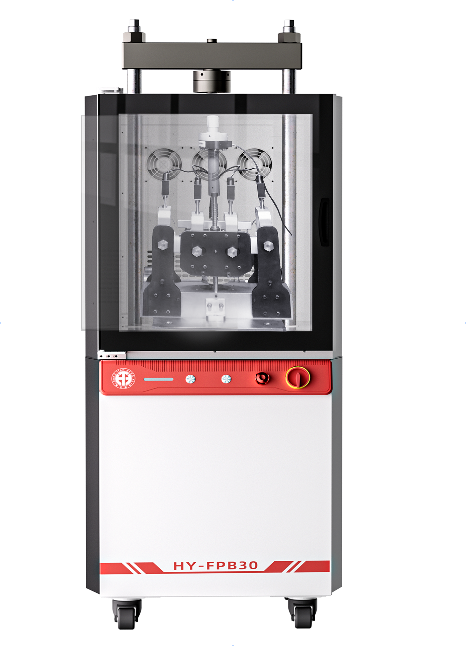
HY-FPB30 is a specialized equipment used to evaluate the fatigue resistance and bending performance of asphalt mixtures, widely applied in road engineering material research, quality control, and mix design. During the asphalt mixture design phase, it optimizes asphalt content and gradation to enhance the mixture’s fatigue resistance while predicting the service life of the pavement under actual operating conditions.
The device utilizes hydraulic loading, offering high loading force and easier control of loading waveforms. It is not only suitable for testing conventional asphalt mixtures but also applicable for testing modified asphalt mixture specimens with high modulus and hardness.
Technical Indicators
Technical Indicators
Loading capacity
30KN
Tension Force
25KN
Force Testing Methods
Bottom-end force measurement
Force sensor accuracy
0.1%
Temperature control method
External circulation fan
Environmental Chamber Features
Visual Window
Loading Method
Stress/Strain
Control Method
PC
Noise Level
55~65 Decibel
Power Supply
AC380V10A
Device Dimensions
700X700X1800(mm)
Controller Module
The controller module integrates the data acquisition system and control software and serves as the central control unit of the entire system. Its stable data acquisition, fully standards-compliant data processing algorithms, and user-friendly interface ensure reliable and efficient system operation.
4-axis / 13-channel control system, capable of simultaneously controlling up to four actuators and acquiring data from 13 sensors.
16-bit A/D conversion resolution, combined with 8× oversampling technology, ensures high-precision and stable data acquisition.
All test results are automatically calculated by the system, eliminating the need for manual calculations by the user.
The fixtures are equipped with RFID identification chips, enabling automatic identification of the installed fixture and preventing test failures caused by mismatches between the software configuration and the fixture.
Supports multiple control modes, including stress, strain, and load-hold control, with automatic switching between modes. Suitable for both dynamic and static testing.
Dynamic control frequency up to 25 Hz, with support for customized waveform output, including sine, square, and triangular waves.
Software Interface
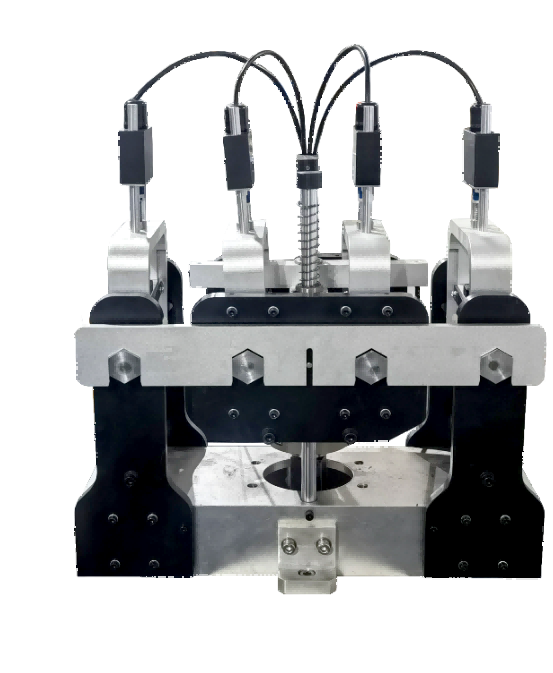
The four-point bending fatigue testis used to determine the fatigue life of asphalt mixtures subjected to repeated flexural loading under specified test conditions.
Two loading waveforms are commonly used: half-sine (haversine) and sine waves. It is generally considered that moving wheel loads produce stress and strain responses in the pavement that approximate a half-sine waveform. Therefore, the half-sine waveform is adopted as the standard loading waveform for the fatigue test.
The test is terminated when the product of flexural modulus and number of load cycles reaches its maximum, or when the flexural stiffness modulus decreases to 50% of its initial value.
Hydraulic station
Servo motor driven, with precise control of pump torque and speed to achieve accurate delivery of flow and pressure.
The servo motor speed is adjustable according to test requirements. Its high response frequency and torque characteristics enable the hydraulic power unit to respond rapidly to system load variations.
Supports switchable remote and local control modes. (Remote control via software; local controller with integrated start and low/high pressure switching functions.)
The hydraulic tank is equipped with a heating function, allowing the hydraulic oil to be preheated during startup in low-temperature environments, thereby accelerating system response and improving test efficiency.
Equipped with integrated sensors for real-time hydraulic oil temperature monitoring. A combined air-cooling and heating control system ensures the oil temperature is consistently maintained within the optimal operating range of 40–60°C, optimizing system performance and extending equipment service life.
Through the coordinated operation of the level sensor and low-level alarm function, the hydraulic system has been upgraded from passive fault response to proactive health management, significantly enhancing operational reliability.