
AMPT Introduction
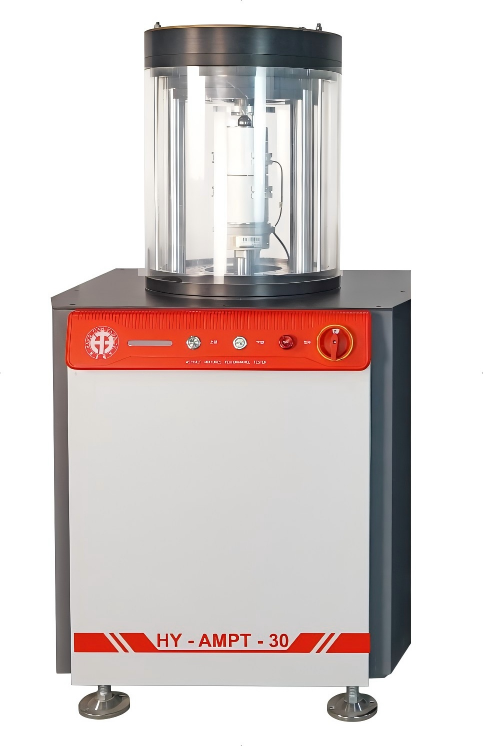
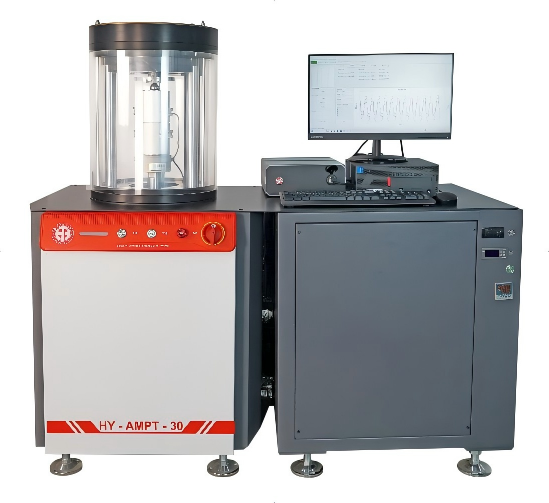
HY-AMPT-30 Asphalt Mixture Performance Tester is an economical and user-friendly dynamic testing machine that employs hydraulic loading. It controls a hydraulic servo valve to achieve waveform output of loading forces, while utilizing high-precision displacement sensors to accurately measure the deformation of specimens during testing. This enables precise evaluation of pavement material properties such as strength, dynamic modulus, and fatigue, simulating various mechanical effects experienced by pavement materials in real-world applications. It holds significant importance for the design, construction, and long-term performance assessment of asphalt pavements.
Based on the AMPT asphalt mixture performance evaluation system, the goal is to ensure practical engineering application. It emphasizes simplicity in specimen preparation, high testing efficiency, low cost, and ease of operation. Furthermore, it establishes a unified theoretical framework, creating an index system that spans from design and evaluation to final engineering acceptance.
Hydraulic Station
- Driven by a servo motor and centered on the “pump-controlled servo” technology, precise control of flow and pressure is achieved through accurate regulation of the pump’s torque and speed.
- The servo motor speed can be adjusted according to test requirements. Thanks to its high response frequency and excellent torque characteristics, the hydraulic station can quickly adapt to changes in system load.
- Remote control and local control switching functions are available (remote control software startup; local controller includes startup and low/high pressure switching functions).
- The oil tank is equipped with a heating function, allowing preheating of the hydraulic oil in low-temperature environments to accelerate system response and improve test efficiency.
- Integrated sensors are configured to monitor hydraulic oil temperature in real time. A combined air cooling and heating control system ensures the oil temperature remains within the ideal working range of 40–60°C, optimizing system performance and extending equipment lifespan.
- Through the synergy of liquid level sensors and low-level alarm functions, the hydraulic system transitions from passive fault response to proactive health management, significantly enhancing operational reliability.
The hydraulic station provides load power for the hydraulic cylinder.In the design of the hydraulic station, a servo motor is used to replace the traditional three-phase motor, featuring a silent design that effectively avoids noise interference with other simultaneous tests.
High-precision filters are added at the inlet and outlet ports to extend the service life of the hydraulic cylinder.
The integrated valve block design simplifies the complexity of the hydraulic circuit.
|
Project |
Parameters |
|
Power |
2.9KW |
|
Flow Rate |
7.8L/min |
|
Maximum Pressure |
25MPa |
|
Power Supply Requirements |
380V 50Hz |
Modular design conceptHost
Module
Built-in dynamic load hydraulic cylinder + high-frequency solenoid valve, generating various pressure waves required for testing (sine wave, versine wave, triangular wave, trapezoidal wave, etc.).
The main displacement sensor is placed inside the hydraulic cylinder, saving space.
The pressure sensor is positioned at the top of the piston rod to avoid generating pressure components. The three-axis column-type reaction frame structure offers higher stability.
Environmental Chamber Module
The environmental chamber uses a double-cavity vacuum composite glass to achieve high-efficiency thermal insulation while enhancing test visibility.
The environmental chamber employs a pneumatic lifting system, allowing one-touch elevation and providing a 360mm barrier-free operating space for test operations.
In the design philosophy of the environmental chamber, the large-space design approach is abandoned. A smaller space ensures higher temperature control precision, faster efficiency, and reduced energy consumption.
No additional confining pressure cylinder is required, allowing direct confining pressure tests such as dynamic modulus and flow value frequency.
The main unit environmental chamber adopts an advanced multi-port directional airflow circulation system for more uniform temperature distribution.

|
Environmental Chamber Parameters |
|
|
Inner Diameter |
320mm |
|
Internal cavity height |
395mm |
|
Confining pressure |
0~300kPa |
Experiment:
Marshall Stability Test;
Asphalt Mixture Splitting Test;
Uniaxial Compression Test;
Dynamic Modulus Test;
Direct Tensile Test;
Flow Value Test。
External Circulation Temperature Control System
Independent temperature control system, based on frequency conversion control principle to regulate the power of cooling or heating.
Equipped with a color LCD touchscreen for precise adjustment of compressor speed and heating device power, achieving accurate temperature control.
The temperature control system is connected to the main unit via flexible material soft connection, avoiding the impact of vibration from the temperature control system on test results.
|
Technical Indicators |
|
|
Maximum loading capacity |
30KN |
|
Pressure measurement accuracy |
5N |
|
Displacement measurement accuracy |
土2.5um |
|
Frequency Range |
0.01~25Hz |
|
Control method |
Hydraulic loading |
|
Environmental Chamber Temperature |
-10°C~60°C |
|
Temperature control method |
External circulation fan |
|
Confining pressure range |
0~300kPa |
|
Noise Level |
2mScope<60dB |
|
Three-Axis Chamber Dimensions |
φ340mmx395mm |
|
Power Requirements |
380V 50Hz |
|
Equipment Size |
700x700x1400(mm) |
|
Temperature control method |
External Circulation Fan |
Dynamic Test Fixture


Specimen Bonding Fixture

Sensor




